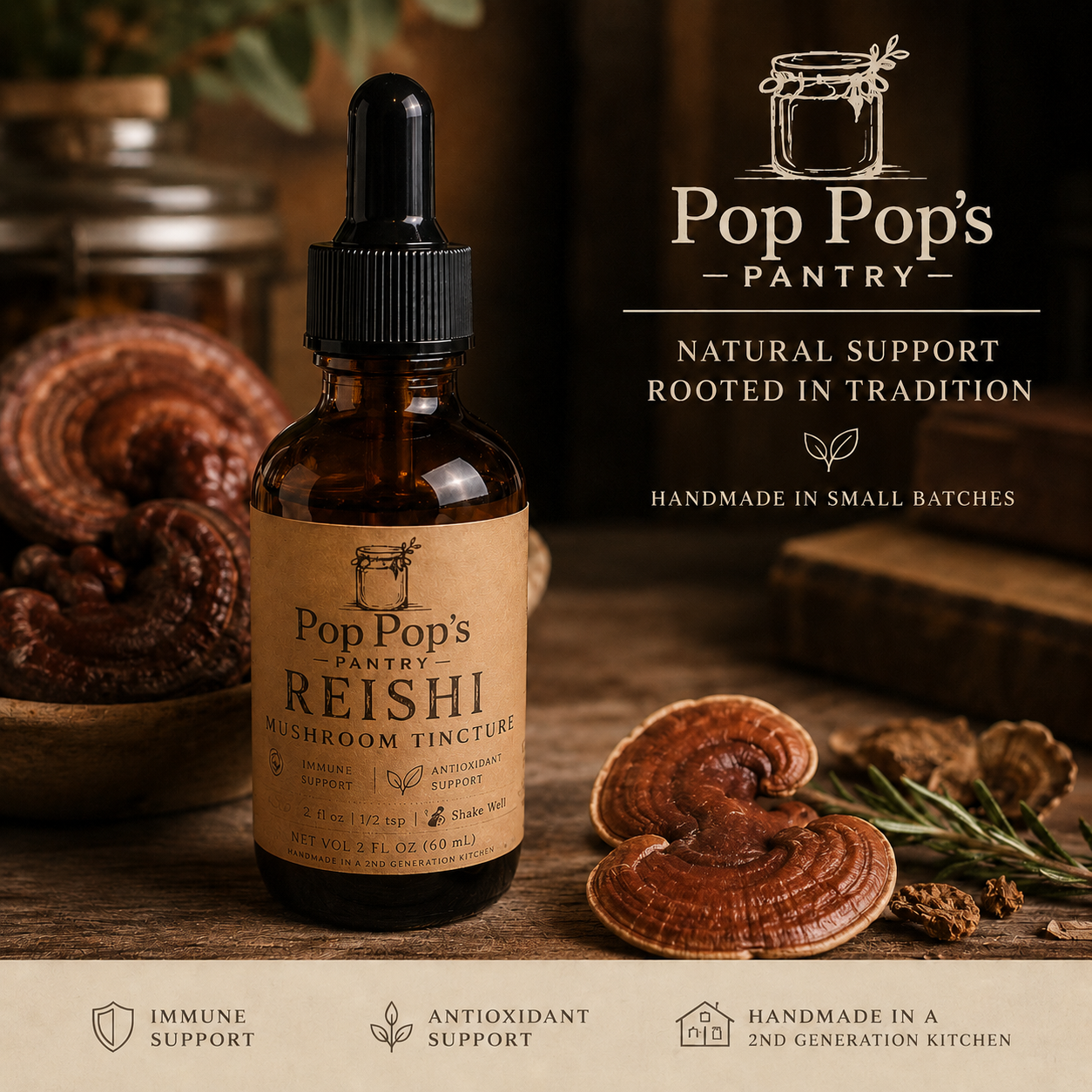
Reishi mushroom (Ganoderma lucidum) has been used in traditional Asian practices for centuries. Today, researchers are studying Reishi for its naturally occurring beta-glucans, triterpenes, polysaccharides and other bioactive compounds that may interact with the immune system, inflammatory pathways and other biological processes.
Unlike caffeine or other stimulants, Reishi doesn't produce one simple, immediate effect. Its compounds appear to interact with several systems within the body, which is one reason this mushroom has attracted so much scientific interest.
What Makes Reishi Special?
Two groups of compounds receive much of the attention in Reishi research:
Beta-glucans and polysaccharides are complex carbohydrates found in the mushroom's cell walls. Researchers are studying their interactions with immune cells and immune-signaling pathways.
Triterpenes, including compounds commonly called ganoderic acids, are another important group of Reishi compounds. Laboratory research has investigated them for antioxidant, inflammatory and other biological activities.
The combination of these compounds makes Reishi considerably more complicated than a supplement containing a single active ingredient.
Step 1: Reishi Enters the Digestive System
When Reishi extract is consumed, it first enters the gastrointestinal tract.
Some smaller compounds can be absorbed through the digestive system, while larger polysaccharides can interact with the intestinal environment.
This matters because the digestive tract and immune system are closely connected.
Certain mushroom polysaccharides can interact with receptors associated with immune cells, potentially affecting the signals those cells use to communicate.
Step 2: Beta-Glucans Interact With Immune Cells
Beta-glucans are among the most studied compounds found in medicinal mushrooms.
Certain immune cells possess receptors capable of recognizing the molecular structures of fungal beta-glucans.
These interactions can influence cells involved in immune defense, including:
Macrophages
Natural killer (NK) cells
Dendritic cells
T cells
B cells
This is why researchers frequently describe medicinal mushrooms such as Reishi as immunomodulators.
That doesn't necessarily mean Reishi simply "boosts" the immune system.
Immune modulation means influencing how different components of the immune system respond and communicate.
That's a much more accurate description of what researchers are investigating.
Step 3: Reishi and Immune Communication
Your immune system depends on an enormous communication network.
Immune cells release chemical messengers called cytokines, which help coordinate immune responses throughout the body.
Laboratory research suggests Reishi polysaccharides can influence several cytokines and immune-signaling pathways.
This interaction between mushroom compounds and immune communication is one of the primary reasons scientists continue studying Reishi.
However, laboratory evidence of immune activity doesn't automatically mean consuming Reishi will prevent infections or treat immune disorders.
Human biology has a habit of being considerably more complicated than a petri dish.
Step 4: Reishi and Inflammatory Pathways
Inflammation is a normal and necessary part of the body's defense and repair systems.
When you're injured or fighting an infection, inflammatory signaling helps coordinate the body's response.
Researchers have found that compounds isolated from Reishi can interact with pathways involved in inflammation.
Triterpenes and polysaccharides from Reishi have demonstrated anti-inflammatory activity in laboratory and animal studies.
This doesn't mean Reishi should be considered an anti-inflammatory medication.
Instead, the research suggests that some Reishi compounds may influence biological pathways involved in regulating inflammatory responses.
Step 5: Reishi and Oxidative Stress
Normal metabolism produces molecules known as reactive oxygen species, often referred to as free radicals.
Your body has its own antioxidant defense systems to keep these molecules under control.
When the balance shifts toward excessive reactive molecules, the resulting condition is called oxidative stress.
Reishi contains compounds that have demonstrated antioxidant activity in laboratory research.
Researchers are investigating whether these compounds can influence the body's response to oxidative stress and help protect cellular structures.
Again, strong antioxidant activity in a laboratory experiment doesn't necessarily translate into the same effect after a person consumes Reishi.
Step 6: Reishi and the Stress Response
Reishi is frequently described as an adaptogenic mushroom and is commonly marketed for relaxation, stress and sleep.
This is an interesting area, but it's also one where marketing claims can move faster than clinical science.
Researchers have investigated Reishi preparations for effects involving fatigue, quality of life and general well-being.
There are plausible biological mechanisms involving immune signaling, inflammation and nervous-system activity, but evidence that Reishi directly reduces stress or reliably improves sleep in humans remains limited.
So rather than saying Reishi "turns off stress," it's more accurate to say researchers are investigating how its compounds may influence biological systems associated with the body's response to stress and fatigue.
Step 7: Reishi Triterpenes
Reishi is particularly interesting because it contains numerous triterpenoids, including ganoderic acids.
These compounds contribute to Reishi's characteristically bitter taste.
Researchers have studied Reishi triterpenes for several potential biological activities involving:
Inflammatory signaling
Oxidative stress
Cellular signaling
Immune responses
Much of this detailed research comes from laboratory and animal studies rather than large human clinical trials.
That's an important distinction whenever discussing the potential health effects of Reishi.
Why Use Reishi Extract?
Like other mushrooms, Reishi has tough cell walls containing chitin.
Humans don't digest chitin particularly well.
Extraction helps release compounds contained within the mushroom material.
Hot-water extraction is commonly used to obtain water-soluble polysaccharides, including beta-glucans.
Alcohol extraction can help obtain triterpenes and other compounds that aren't as readily soluble in water.
This is why some Reishi products use a dual-extraction process, combining water and alcohol extraction to capture a broader range of compounds.
The extraction method can therefore significantly affect what's actually present in the finished Reishi product.
Reishi and the Gut
Scientists are also investigating interactions between medicinal mushroom polysaccharides and the gut microbiome.
Some mushroom polysaccharides aren't completely digested in the upper gastrointestinal tract.
They can reach the intestine, where microorganisms may interact with or ferment them.
Because the intestinal microbiome and immune system communicate extensively with each other, researchers are investigating whether this represents another pathway through which Reishi compounds influence the body.
This remains an emerging area of research.
What Does Human Research Actually Show?
Reishi has an impressive amount of laboratory research behind it, but the human evidence is considerably less definitive.
Clinical studies have investigated Reishi for immune function, fatigue, quality of life and several medical conditions.
Results have been mixed, and many studies have been relatively small.
That's why it's important to separate three things:
Traditional use
Promising laboratory research
Clinically proven effects in humans
They aren't interchangeable.
Reishi contains biologically active compounds worthy of scientific investigation, but it shouldn't be presented as proven to prevent, cure or treat disease.
A Few Important Precautions
Natural doesn't automatically mean risk-free. Hemlock is natural too, and nobody is putting that in their morning smoothie.
Reishi may interact with medications or medical conditions.
Particular caution may be appropriate for people taking anticoagulant or antiplatelet medications, medications affecting blood pressure or blood sugar, or medications that influence immune function.
Rare cases of liver injury have also been reported in association with some Reishi products, although determining cause can be difficult.
Anyone with a medical condition, taking prescription medication, pregnant or breastfeeding should discuss Reishi supplementation with a qualified healthcare professional.
The Bottom Line
Reishi doesn't appear to work through one single mechanism.
Instead, scientists are investigating several interconnected pathways:
Beta-glucans → immune-cell signaling
Polysaccharides → immune and gut interactions
Triterpenes → inflammatory and cellular pathways
Antioxidant compounds → oxidative-stress research
This combination helps explain why Ganoderma lucidum has remained one of the world's most widely studied medicinal mushrooms.
The science doesn't tell us that Reishi is a miracle mushroom.
It tells us something considerably more interesting: Reishi contains a remarkably complex collection of compounds capable of interacting with multiple biological systems within the human body.
And researchers are still working to understand exactly what those interactions mean for human health.
Pop Pops Pantry
This article is provided for educational purposes only and is not intended to diagnose, treat, cure or prevent any disease. Research into Reishi and its compounds is ongoing. Mushroom products should not be used as a substitute for medical care or prescribed treatment.