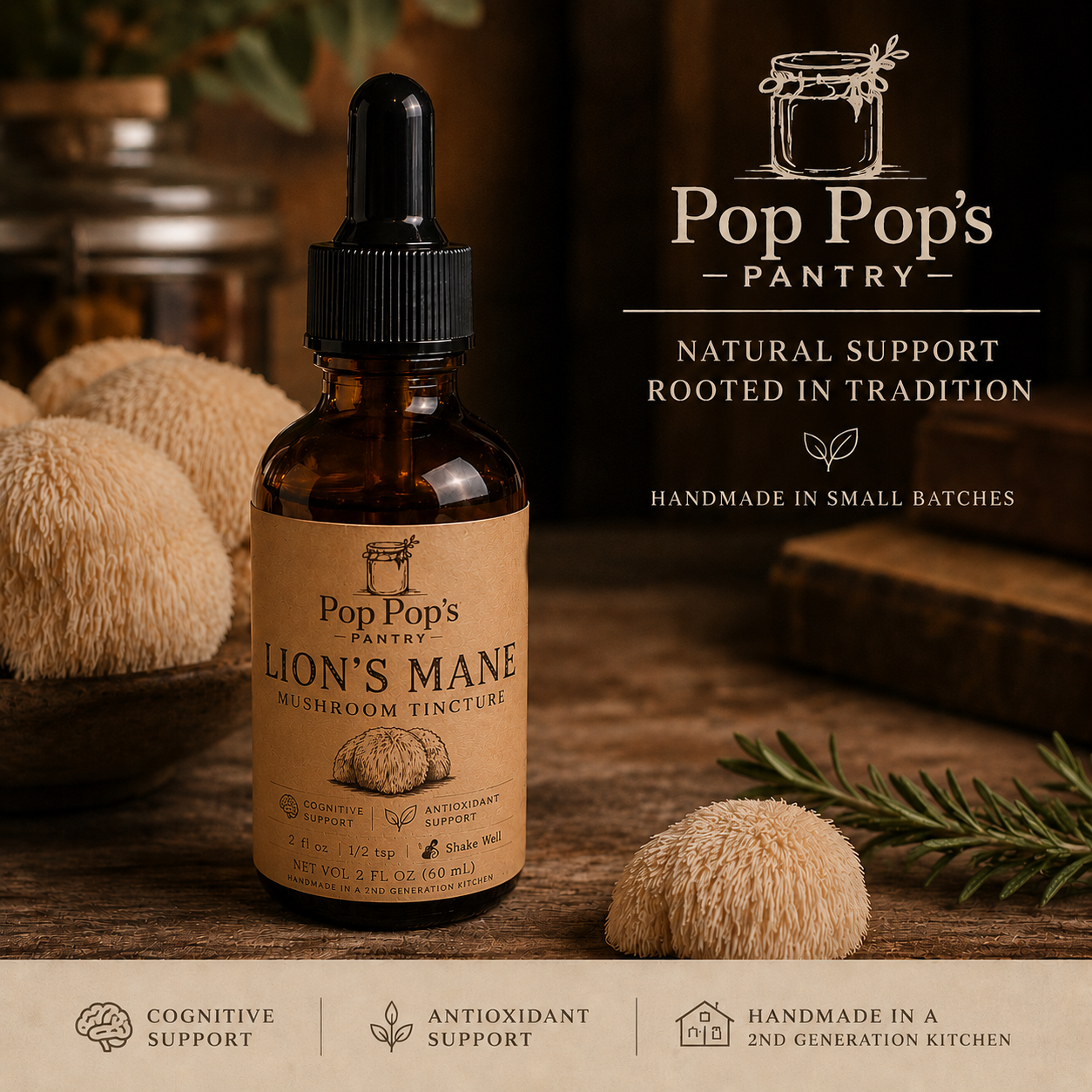
Lion’s Mane mushroom (Hericium erinaceus) has become increasingly popular among people interested in memory, focus, mental clarity, and overall brain health.
But what actually happens when Lion’s Mane interacts with the brain?
The answer may involve something called Nerve Growth Factor, or NGF.
What Is Nerve Growth Factor?
Nerve Growth Factor is a naturally occurring protein that plays an important role in the growth, maintenance, and survival of certain nerve cells.
Think of NGF as part of the brain and nervous system’s maintenance and communication network. It helps certain neurons remain healthy and maintain the connections they use to communicate.
Researchers studying Lion’s Mane have discovered several naturally occurring compounds that may influence pathways associated with NGF and nerve health.
The Compounds Inside Lion’s Mane
Two groups of compounds receive much of the scientific attention:
Hericenones are primarily associated with the fruiting body of the Lion’s Mane mushroom.
Erinacines are primarily associated with Lion’s Mane mycelium.
Laboratory and animal research suggests that some of these compounds may influence biological pathways involved in Nerve Growth Factor production and signaling.
That does not mean Lion’s Mane simply puts NGF into your brain. Instead, researchers are investigating whether compounds in the mushroom may encourage the body’s own nerve-supporting processes.
Lion’s Mane and Neuroplasticity
One particularly interesting area of research involves neuroplasticity.
Neuroplasticity is the brain’s ability to adapt, reorganize, and form new connections throughout life. It is involved in learning, memory, and the brain’s response to new experiences.
Early research suggests that compounds found in Lion’s Mane may support some of the biological processes associated with neuronal growth and communication.
Lion’s Mane, Memory and the Hippocampus
Scientists have also studied Lion’s Mane in connection with the hippocampus, an area of the brain that plays an important role in learning and memory.
Animal research has produced interesting findings, and several small human studies have investigated Lion’s Mane for cognitive function and mood.
The results are encouraging enough to warrant continued research, but human research remains limited. Larger and longer clinical studies are still needed.
Does Lion’s Mane Grow New Brain Cells?
You may have seen claims online that Lion’s Mane “regenerates the brain” or “grows new neurons.”
The science isn't nearly that simple.
Laboratory and animal studies have found evidence suggesting that compounds in Lion’s Mane can influence nerve-growth and neuroprotective pathways. However, that does not establish that taking Lion’s Mane supplements will regenerate damaged brain tissue or treat neurological diseases in humans.
There is an important difference between promising biological research and a proven medical treatment.
Why We Find Lion’s Mane So Interesting
What makes Lion’s Mane fascinating isn't a miracle claim.
It's the biology.
A mushroom contains naturally occurring compounds that researchers are investigating for their potential relationships with NGF, neuronal health, neuroplasticity, memory, and other aspects of nervous-system function.
Scientists are still figuring out exactly what these compounds do in humans, how much is required, and which extraction methods and mushroom components provide the most useful compounds.
That is precisely why Lion’s Mane continues to attract scientific attention.
The Bottom Line
Lion’s Mane is one of the most interesting functional mushrooms being studied today.
Research suggests that compounds found in Lion’s Mane may support pathways associated with Nerve Growth Factor, neuroplasticity, neuronal health, memory, and cognitive function.
But research is ongoing, and Lion’s Mane should not be viewed as a treatment or cure for neurological or medical conditions.
At Pop Pops Pantry, we believe the best approach is simple: learn what the research actually says, understand what we still don't know, and let the science speak for itself.
Pop Pops Pantry
Veteran Owned
PopPopsPantry.com
This information is provided for educational purposes only and is not intended to diagnose, treat, cure, or prevent any disease.