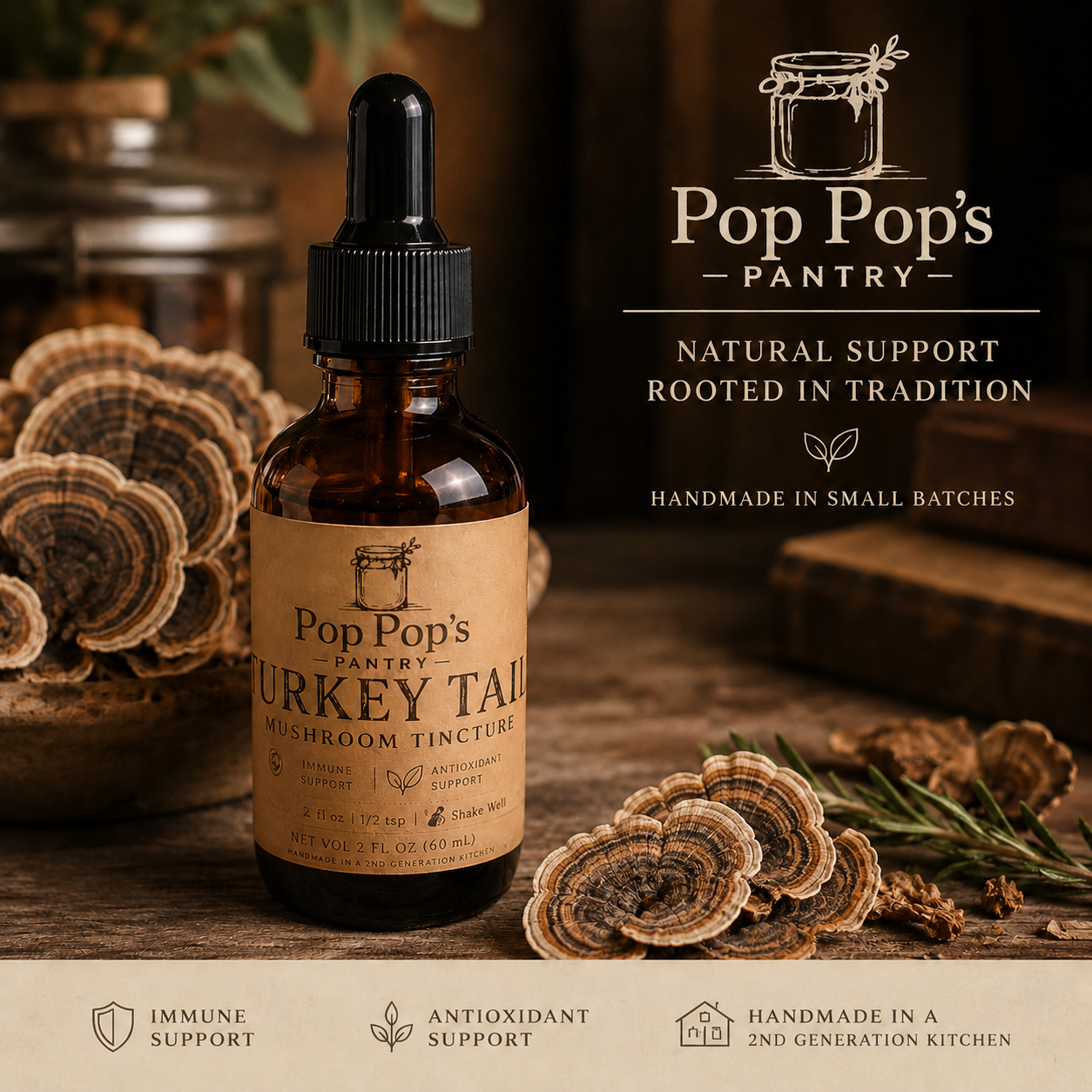
Turkey Tail mushroom (*Trametes versicolor*) may have a funny name, but it has become one of the most studied medicinal mushrooms for its potential effects on the immune system.
Unlike something such as caffeine, which produces an effect you can often feel fairly quickly, Turkey Tail appears to work primarily by interacting with the body's immune system and digestive tract.
## What Makes Turkey Tail Special?
Turkey Tail contains complex carbohydrates known as **polysaccharides**, including **beta-glucans**. Researchers have also extensively studied two protein-bound polysaccharides derived from Turkey Tail known as **PSK (polysaccharide-K)** and **PSP (polysaccharopeptide)**.
These compounds are particularly interesting because they appear to interact with immune cells rather than simply acting as vitamins or nutrients.
## Step 1: Turkey Tail Reaches the Digestive System
When Turkey Tail extract is taken orally, many of its larger polysaccharides are not simply absorbed into the bloodstream like a small drug molecule.
Instead, they encounter the intestinal environment, where the gut and immune system are closely connected.
This matters because a large portion of the body's immune activity is associated with tissues surrounding the gastrointestinal tract. Turkey Tail polysaccharides can interact with immune signaling pathways there, while other components may interact with the intestinal microbiome.
Think of Turkey Tail less like adding fuel to the immune system and more like providing biological signals that immune cells can recognize.
## Step 2: Beta-Glucans Interact With Immune Cells
Beta-glucans have structures that the immune system is capable of recognizing.
Immune cells such as **macrophages, monocytes and dendritic cells** contain receptors capable of detecting certain fungal components. When these receptors encounter mushroom polysaccharides, they can trigger signaling pathways that influence immune activity.
This is why researchers commonly describe Turkey Tail as an **immunomodulator**.
That distinction is important.
Rather than simply saying Turkey Tail "boosts" immunity, it is more accurate to say that compounds found in Turkey Tail have demonstrated the ability to **modify or influence immune responses** in laboratory and clinical research.
## Step 3: Immune Communication Can Change
Your immune system is essentially an enormous communication network.
Immune cells communicate using chemical messengers called **cytokines**. Research involving Turkey Tail compounds such as PSP and PSK has demonstrated changes in several cytokines and immune-signaling pathways.
Studies have reported effects involving:
* Macrophages
* Natural killer (NK) cells
* T cells
* B cells
* Dendritic cells
* Cytokine production
* Antibody responses
These effects help explain why Turkey Tail has received so much scientific attention as an immune-modulating mushroom.
## Step 4: Natural Killer Cells and Immune Surveillance
One especially interesting area of Turkey Tail research involves **natural killer cells**, usually called NK cells.
NK cells are part of the body's innate immune system. They patrol the body looking for abnormal or infected cells.
Laboratory and clinical research involving Turkey Tail preparations has reported changes in NK-cell activity and other measures of immune function.
That doesn't mean Turkey Tail itself "kills cancer" or cures infections. Instead, researchers are investigating how compounds in the mushroom influence the body's own immune-surveillance systems.
That is an important difference, particularly when discussing medicinal mushrooms responsibly.
## What Are PSK and PSP?
Two of the most researched compounds associated with Turkey Tail are **PSK** and **PSP**.
PSK has been studied extensively in Japan, while PSP has received considerable research attention in China and elsewhere.
These aren't simply ordinary powdered Turkey Tail. They are specialized polysaccharide-protein preparations derived from the mushroom.
PSK has even been used in Japan as an **adjunct to conventional cancer treatment**, meaning it has been used alongside treatments such as chemotherapy rather than as a replacement for them.
Research into PSK and PSP is one reason scientists became so interested in Turkey Tail's effects on immune function.
## Why Use an Extract?
The cell walls of mushrooms contain tough structural material, including chitin.
Extraction allows water-soluble compounds, including many of the polysaccharides researchers are interested in, to be separated and concentrated from the mushroom material.
This is why a properly prepared Turkey Tail extract is different from simply grinding dried Turkey Tail mushrooms into powder.
The extraction method, mushroom material used and concentration of beta-glucans can all affect the final product.
## Turkey Tail and the Gut
Another developing area of research concerns Turkey Tail and the **gut microbiome**.
Some mushroom polysaccharides can reach the large intestine, where intestinal microorganisms can interact with and ferment them. This has led researchers to investigate whether medicinal mushrooms may have **prebiotic-like effects** that influence the composition or activity of gut bacteria.
Because the intestinal microbiome and immune system communicate extensively with one another, this could represent another pathway through which Turkey Tail affects the body.
Research in this area is still developing.
## What Does the Research Actually Tell Us?
Turkey Tail has legitimate scientific research behind it, particularly concerning immune modulation and the extensively studied compounds PSK and PSP.
However, research performed on standardized PSK or PSP preparations cannot automatically be applied to every Turkey Tail tincture, powder or supplement on the market.
Different products may contain very different concentrations and types of biologically active compounds.
Turkey Tail should therefore be viewed as a fascinating medicinal mushroom with biologically active compounds that researchers continue to investigate, rather than as a cure for disease.
## The Bottom Line
Turkey Tail appears to work primarily through its complex polysaccharides and related compounds.
After entering the digestive system, these compounds can interact with the gut environment and immune system. Research suggests that Turkey Tail compounds can influence macrophages, natural killer cells, T cells, B cells and the chemical signals these cells use to communicate.
That ability to influence immune function is what makes *Trametes versicolor* one of the most extensively researched medicinal mushrooms in the world.
Sometimes the most interesting thing about mushrooms isn't what they do directly. It's what they encourage the human body to do for itself.
**Pop Pops Pantry**
*This article is provided for educational purposes only and is not intended to diagnose, treat, cure or prevent any disease. Mushroom products should not be used as a substitute for medical care or prescribed treatment.*